 Khaled Koubaa
A quiet but transformative evolution is underway in how consumers interact with businesses. In a world where convenience is paramount, attention spans are fleeting, and expectations are shaped by digital-first players like Amazon, Uber, and Airbnb, the question facing every company is no longer just What do you sell? But how digital are you?
Yet, consumers today have no clear way to compare businesses based on their digital capabilities. And many businesses don't even know where they stand. It's time for that to change.
Digital readiness is no longer optional.
We've entered an era where digital capability is the new baseline for trust and loyalty. A restaurant without online reservations, a grocery store without self-checkout, a hotel without seamless self-check-in/out, and a theme park without a mobile app all seem out of step with modern customer expectations. But right now, there's no standard way to assess this. Consumers shop based on price or reviews, while businesses benchmark against quality or brand prestige. Digital capabilities, despite being the layer that mediates the entire user experience, are rarely visible, let alone compared.
This invisibility poses two significant problems. First, consumers can't make informed choices about which businesses will offer a smooth, digitally enabled experience. Second, businesses are left flying blind, unable to benchmark their digital maturity or understand how their digital shortcomings are costing them.
Most organizations rigorously measure product quality, financial health, and ESG performance today. These are critical dimensions of operational excellence. However, conspicuously missing from the equation is a clear and consistent measure of digital worthiness: how well a business leverages digital technologies to serve customers effortlessly. When digital transformation is assessed at all, it's often done through internal audits that dig deep into systems, workflows, and organizational readiness. While valuable, these internal diagnostics risk missing the forest for the trees: the primary purpose of digital is to enhance the customer experience. If audits don't measure how digital improves the customer experience, they miss the mark.
AI can make digital capability measurable and comparable at scale.
Until recently, measuring digital capabilities across industries was a complex and subjective task. But AI has changed the equation. With advancements in public data extraction, machine learning, and natural language processing, it's now possible to assess a business's digital footprint in real-time, from the structure of its website to the availability of mobile apps, customer service responsiveness, payment options, accessibility features, and more.
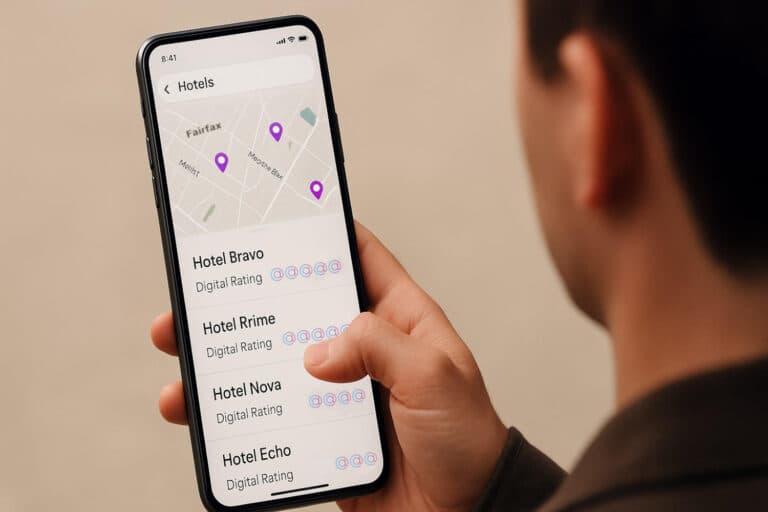
Imagine a rating system that can scan millions of businesses and assign a digital readiness score based on publicly observable indicators, similar to how credit scores assess financial health or energy labels rate appliance efficiency. Such a system could empower consumers to choose businesses that align with their digital expectations while giving companies a roadmap to improve.
This isn't a theoretical exercise. Governments are beginning to tie digital maturity to procurement eligibility. Investors increasingly examine digital resilience as part of ESG metrics. And small businesses face mounting pressure to "go digital" without knowing what that means in practical, measurable terms.
Why this matters now: the digital divide is widening, fast.
The gap between digital leaders and laggards is no longer just a strategic distinction; it's an existential fault line. The post-pandemic world has accelerated digital adoption but also revealed deep asymmetries in capability. Those offering smooth, responsive, omnichannel experiences win customer trust and loyalty, those who cannot are left behind, often without realizing it until it's too late.
This translates into friction, frustration, and missed opportunities for consumers. For businesses, it means silent churn, wasted marketing spend, and growing irrelevance.
Digital worthiness, the ability to offer a digitally enabled experience, is emerging as a new axis of differentiation, on par with price and quality. However, while those two dimensions are visible and legible, digital capability remains hidden and inconsistent. We need a new way to surface, standardize, and compare it.
A new digital standard for the age of intelligent systems
To build a more transparent, competitive, and equitable digital economy, we need to bring visibility to the invisible layer of digital performance. An AI-powered system can help us do just that.
This is not just a tool for large enterprises. It's more vital for small and medium businesses, which often lack the resources to self-diagnose or keep pace with evolving expectations. A common, accessible standard for digital capability could help level the playing field, reduce the digital divide, and encourage a culture of continuous improvement.
The moment is ripe. The tools exist. We need a shift in mindset from treating digital maturity as a buzzword or back-office concern to recognizing it as a primary vector of consumer choice, institutional credibility, and economic resilience.
We can't improve what we can't see. It's time to rate the digital.
As AI reshapes industries and expectations, we must use its power not just to automate, but to illuminate. In a world where digital readiness is measured, compared, and improved, consumers make better choices, businesses operate more effectively, and technology serves transparency rather than obscurity.
That's a future worth building before we fall further behind.